
Express News UK: What You Need to Know About the Daily Express Today
The Daily Express is one of the UK’s longest-running newspapers, but what does it actually offer in 2025? If you’re reading it for news, you need to understand its history, its bias, and how it’s changed - or hasn’t - over the last 125 years. It’s not just another paper. It’s a mirror of a certain kind of British identity: proud, skeptical of authority, and deeply attached to tradition.
What Is the Daily Express?
The Daily Express launched on April 24, 1900, as a half-penny paper aimed at working-class readers who wanted clear, fast news without the stuffiness of broadsheets. It was revolutionary at the time: the first British paper to put news - not ads - on the front page. By the 1930s, it was selling over two million copies a day, making it the most widely read newspaper in the world. Today, print sales have dropped to around 200,000 daily copies, but its website, express.co.uk, still draws millions of visitors each month.
It’s owned by Reach plc, the same company that runs the Daily Mirror and the Liverpool Echo. The paper’s physical format is tabloid - smaller, punchier, designed for quick reading on the commute or over breakfast. Its tone is direct, emotional, and often dramatic. Headlines like “BRITAIN’S LAST CHANCE” or “EUROPE BETRAYS US” aren’t accidental. They’re carefully crafted to trigger a reaction.
Political Stance: Right-Wing Through and Through
If you’re looking for neutral reporting, the Daily Express isn’t it. It’s consistently ranked as the most right-wing national newspaper in the UK. Since the 1930s, it’s backed Conservative Party candidates in over 90% of general elections. During the Brexit campaign, it ran front pages declaring “ENOUGH IS ENOUGH” and “VOTE TO TAKE BACK CONTROL.” In 2023, it still leads with stories about immigration, sovereignty, and what it calls “the cost of globalism.”
Academic studies back this up. Professor John Thompson from Cambridge called it “the most consistently right-wing national newspaper in Britain.” Media watchdogs like the Media Reform Coalition gave it a 2.1/5 for accuracy in 2022, citing frequent use of unverified claims, especially on immigration and the EU. It’s not that the Express doesn’t report facts - it’s that it picks which facts to highlight, and which to ignore.
Compare it to The Guardian, which leans left, or The Times, which tries to stay center. The Express doesn’t pretend to be balanced. It speaks to a specific audience: older, often working-class readers who feel left behind by modern politics. That’s why it still sells - not because it’s the most accurate, but because it feels like home to its readers.
How It Compares to Other UK Papers
Here’s how the Daily Express stacks up against other major UK newspapers:
| Publication | Format | Political Lean | 2022 Print Circulation | Digital Strength |
|---|---|---|---|---|
| Daily Express | Tabloid | Right-wing | 201,608 | High traffic, strong app |
| Daily Mail | Tabloid | Right-wing | 1,025,000 | World’s most visited newspaper site |
| The Sun | Tabloid | Right-wing | 1,200,000 | Strong social media |
| The Times | Broadsheet | Center-right | 380,000 | High-quality digital subscription |
| The Guardian | Broadsheet | Left-wing | 180,000 | Massive online audience, free model |
The Express doesn’t compete with The Times on depth. It competes with the Daily Mail and The Sun on emotion. Where the Mail leans into celebrity gossip and lifestyle, the Express leans into politics, patriotism, and perceived threats to British identity. Its sports coverage is solid but secondary. Its real power is in shaping opinion, not just reporting it.

What Readers Say - And Why They Stick Around
Online reviews are split. On Trustpilot, the Express website has a 2.7 out of 5 stars. The complaints? “Sensational headlines,” “political bias,” “clickbait.” But the people who give it 5 stars say things like: “Finally, a paper that tells the truth about immigration,” or “I’ve read it for 40 years - it speaks for people like me.”
On Reddit, threads like “How reliable is the Express?” get hundreds of comments. One user, u/NewsWatcherUK, said: “I’ve subscribed for 15 years - they get major news events right, but frame stories with a clear right-wing slant that requires mental adjustment.” That’s the key. Many readers don’t read it to be unbiased. They read it to feel understood.
Its audience is aging. Nearly 70% of print readers are over 55. That’s a problem for the future. But its digital audience is younger than you’d think - partly because of viral headlines and partly because younger readers are curious about the other side of the political divide. The Express isn’t dying. It’s evolving.
How to Read the Express - Without Being Misled
If you’re reading the Daily Express, here’s how to stay sharp:
- Check the headline vs. the article. Headlines are designed to shock. The body might be more measured - or not.
- Look for sources. If a story says “sources say” or “experts claim,” ask: who? Is it a named expert, or just “a source”? The Express often uses unnamed officials.
- Watch for emotional language. Words like “betrayal,” “invasion,” “crisis,” or “disaster” are red flags. They’re not neutral descriptors.
- Compare with BBC or Reuters. If the Express is the only outlet running a story, be skeptical.
- Know the difference between news and opinion. Opinion pieces are clearly labeled, but the line often blurs. A column titled “My View” is opinion. A story titled “Immigration Surge Hits Town” might be presented as fact - but the framing is opinion.
Don’t avoid the Express. Use it. It’s a valuable window into a large section of British society. Just don’t mistake its perspective for the whole truth.
Digital Access and Subscription Costs
You can read the Daily Express in three ways:
- Print copy: £1.80 Monday to Saturday, £2.20 on Sunday. Available at newsagents across the UK.
- Free online: You can read five articles per month without signing up. After that, you hit a paywall.
- Subscription: £15 a month or £120 a year for unlimited access to express.co.uk and the iOS/Android apps. No ads in the app version.
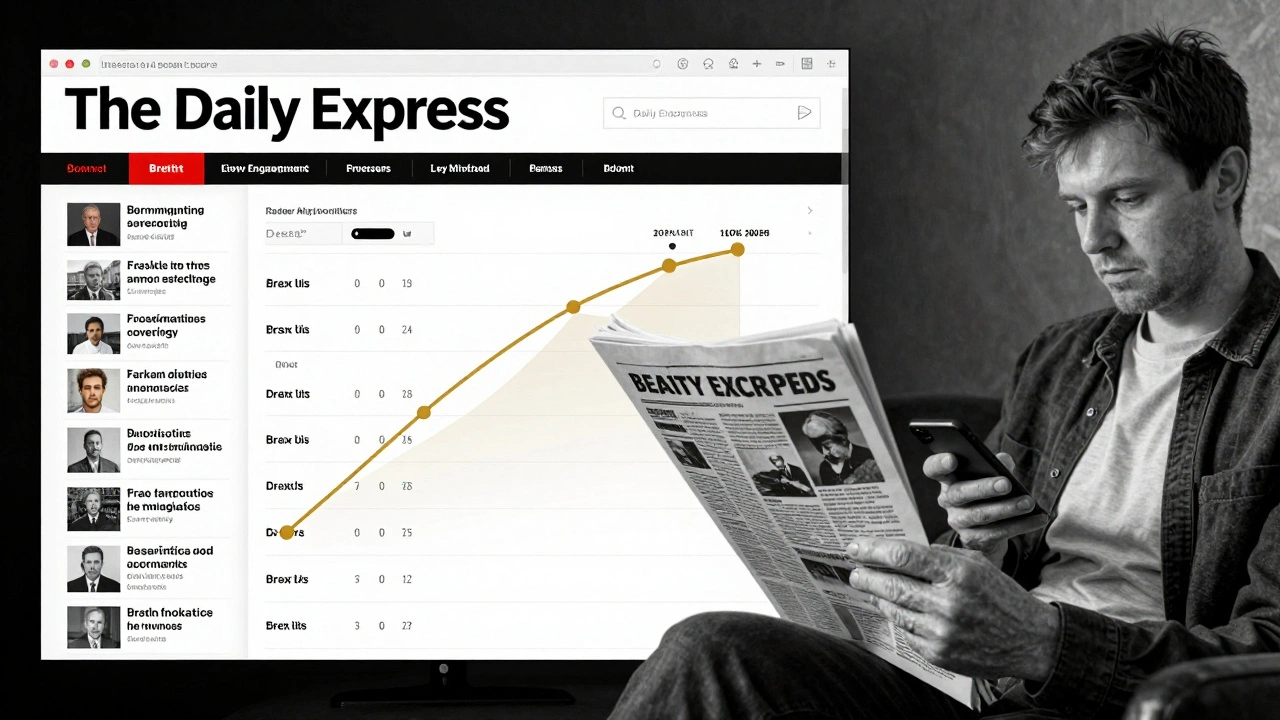
Reach plc invested £20 million in digital upgrades in 2022. The site now uses AI to personalize content. If you click on Brexit stories, you’ll see more of them. If you read about celebrities, you’ll get more celebrity news. It’s not just a newspaper anymore - it’s a feedback loop.
The Future of the Daily Express
Print will keep declining. By 2025, experts predict print sales could fall below 150,000. But digital subscriptions are expected to hit 180,000 - meaning the Express might actually grow its total audience, just not on paper.
It’s opening new regional news hubs in Manchester and Glasgow by late 2024. That’s a smart move. Local stories build loyalty. It’s also expanding its video team - producing over 120 short videos a week now, up from 45 in 2020.
Its biggest risk? Losing relevance with younger readers. But its biggest strength? It doesn’t need to please everyone. It’s built a loyal base that trusts it - even when others don’t. That kind of loyalty is rare in media today.
The Daily Express isn’t going away. It’s changing shape. And if you want to understand a certain kind of Britain - the one that voted Brexit, that worries about borders, that feels ignored by the media - then you need to know what it says. Just read it with your eyes open.
Is the Daily Express a reliable news source?
The Daily Express is reliable for reporting major events - like elections, royal news, or major accidents. But its editorial framing is strongly right-wing, and it frequently uses emotionally charged language, unverified claims, and selective reporting - especially on immigration, the EU, and crime. Media watchdogs rate its accuracy below average. Treat it as a perspective, not a neutral source.
How does the Daily Express make money?
The Daily Express earns revenue through print sales, digital subscriptions (£15/month or £120/year), and advertising. Its website generates income from display ads and sponsored content. Reach plc, its parent company, also sells data and digital marketing services based on reader behavior. The paper’s digital growth is now more important than its print sales.
Can I read the Daily Express for free?
Yes - but only up to five articles per month without a subscription. After that, you’ll be blocked by a paywall. You can still read headlines and summaries, but full articles require a paid subscription. Some articles may be shared freely on social media, but those links often expire after a few days.
Is the Daily Express the same as the Sunday Express?
No. The Sunday Express is a separate publication, launched in 1918, and appears every Sunday. It has its own editorial team and often features longer investigative pieces, lifestyle content, and weekend reviews. While it shares the same political slant and branding, it’s not just a Sunday version of the daily paper.
Why does the Daily Express still have readers if its print sales are so low?
Because its core audience - older, conservative, and loyal - still values the physical paper and trusts its voice. Even with declining print numbers, its digital reach is growing. Many readers don’t just read the news - they read it to affirm their worldview. That kind of emotional connection keeps people coming back, even when other outlets have more accurate reporting.


About Author
