
Is there a homeless crisis in the UK? The hard data behind the numbers
The UK isn’t just seeing more people sleeping on the streets-it’s witnessing a system buckling under the weight of its own failures. In 2024, nearly 300,000 households in England experienced acute homelessness, a 21% jump from just two years earlier. That’s not a slow creep. It’s a surge. And behind every number is a child sharing a bed, a parent sleeping in a B&B with no kitchen, or someone curled up in a doorway because there’s literally nowhere else to go.
What does ‘homelessness’ actually mean today?
Most people picture someone sleeping rough on a pavement. But that’s only the tip of the iceberg. The real crisis is hidden in plain sight. Over 131,000 households were stuck in temporary accommodation by March 2025-up 11.8% from the year before. These aren’t luxury hotels. They’re cramped hostels, noisy B&Bs, and converted offices with no cooking facilities. One in three children in these homes have to share a bed. Some families move every few weeks. Schools lose track of them. Parents miss work. Mental health spirals. Then there’s the invisible group: people couch-surfing, sleeping in cars, or staying in unsanctioned squats. These aren’t counted in official stats, but charities say they make up at least half of all homelessness. The Crisis report estimates over 15,000 people slept rough in 2024 alone-up 150% since 2020. That’s not a statistic. That’s a moral failure.Who’s most affected?
It’s not just one group. It’s everyone, but some harder than others. Young people under 25 make up 27% of all homeless individuals-that’s over 205,000 people, up 29% from 2023. Many are leaving care, fleeing abuse, or kicked out after a relationship breakdown. Then there’s the 35-44 age group, where 35 out of every 10,000 people experienced homelessness in 2024-the highest rate of any age group. These are people who had jobs, homes, families. Then came job loss, benefit delays, or a rent hike they couldn’t afford. Families with children account for 63% of those in temporary housing. That’s 83,150 households. In London, the numbers are worse. One in every 14 households in temporary accommodation lives there because they were evicted from asylum support housing-a 37% rise in just one year. Others are discharged from hospitals or prisons with nowhere to go. The government’s early release program for prisoners has flooded the system with people who have no home, no support, and no safety net.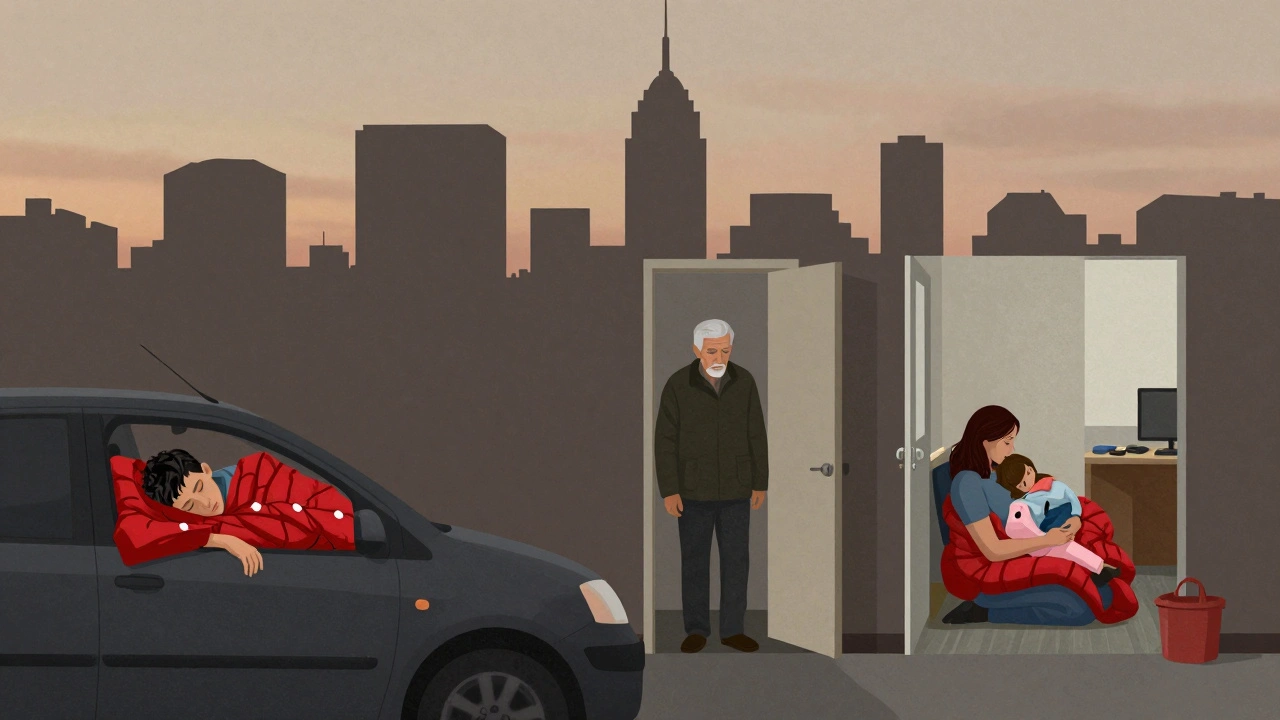
Why is this happening now?
It’s not one thing. It’s a perfect storm. Housing benefit hasn’t kept up with rent prices. The Local Housing Allowance (LHA) was frozen in 2020. Today, it covers fewer than 3% of private rental properties in England. That means even if you have a job and a benefit, you still can’t find a place to live. In 2010, LHA covered the bottom third of rents. Now? It barely covers the bottom 1%. At the same time, social housing has vanished. Since 2010, England has lost around 170,000 social homes-mostly through right-to-buy schemes and no replacements. Councils can’t build fast enough. Private landlords are pulling out. Rents keep rising. And the people who need help the most? They’re stuck in a loop: apply for housing, get denied, end up in temporary accommodation, then get moved again because the place is full or unsafe. The Homelessness Reduction Act of 2018 tried to fix this by forcing councils to help people earlier. But most councils say they don’t have the staff or money to do it properly. Only 63% report having adequate resources. Meanwhile, spending on homelessness has more than doubled since 2010-from £1.4bn to £3.8bn in 2024/25. That sounds like progress. But it’s just keeping pace with the explosion in need. It’s not solving the problem. It’s managing the fallout.Where is it worst?
London is the epicenter. It holds 33,790 of the 131,140 households in temporary accommodation across England-over a quarter of the total. Islington has seen a 163% rise in homelessness since 2020. Wandsworth, Camden, and Lambeth aren’t far behind. But it’s not just London. Northern cities like Manchester, Liverpool, and Bradford are seeing sharp increases too. Meanwhile, places like Thanet in Kent have actually seen a 44% drop in homelessness rates-thanks to local prevention programs, not national policy. The pattern is clear: where housing is scarce and wages are low, homelessness spikes. Where councils invest in early intervention-like rent advice, mediation, or emergency grants-rates fall. But those are the exceptions. Most places are overwhelmed.
What’s being done-and why it’s not enough?
The government says it’s acting. It’s poured billions into temporary housing. It’s expanded the duties of councils. But the core problems remain untouched. Rent controls? None. Social housing construction? At a crawl. LHA reform? Delayed. The Institute for Government says the system is “financially unsustainable.” By 2027/28, spending could hit £5bn a year if nothing changes. Experts like Professor Glen Bramley from Heriot-Watt University say targeted fixes could cut homelessness by 23% in five years: build 90,000 new social homes annually, raise LHA to cover the bottom third of rents, and plug the gaps for people leaving institutions. But none of these are happening at scale. Charities like Shelter and Crisis are calling for urgent action. They want the LHA unfrozen. They want a national housing strategy. They want to end the practice of placing families in B&Bs for months on end. They want real homes, not temporary boxes. Meanwhile, councils are doing what they can. Some are offering rent guarantees to private landlords. Others are partnering with housing associations. A few have even bought properties outright to keep them as permanent social housing. But these are drops in a bucket.The human cost
Behind every statistic is a story. A mother in Birmingham who’s been in a hostel for 18 months, moving every three weeks because the room is infested with rats. A 17-year-old who left care and now sleeps in a park because no council will take him. A veteran discharged from hospital with PTSD and no housing plan. A family forced to choose between heating and eating because their temporary flat has no insulation. Children miss school. Parents lose jobs. Mental health deteriorates. Emergency services get overwhelmed. The cost to society isn’t just financial-it’s emotional, generational, and moral. This isn’t about politics. It’s about survival. In a country with the world’s sixth-largest economy, no one should be sleeping on the street. No child should share a bed because there’s no room. No person should be told they’re not eligible for help because they didn’t fill out the right form in time. The data doesn’t lie. The crisis is real. And it’s getting worse.


About Author
