What Is the Most Read News Website in the US? Traffic, Trust, and Trends in 2025
News Website Comparison Tool
See how major US news sites compare based on different metrics. Click a metric to see which site leads.
Select a metric to see results
When you open your phone in the morning, which news site do you check first? For millions of Americans, the answer is The New York Times. But here’s the twist: if you’re looking at search traffic alone, Yahoo News might be on top. So who’s really the most read? It depends on how you define "read."
Who Leads in Total Monthly Visits?
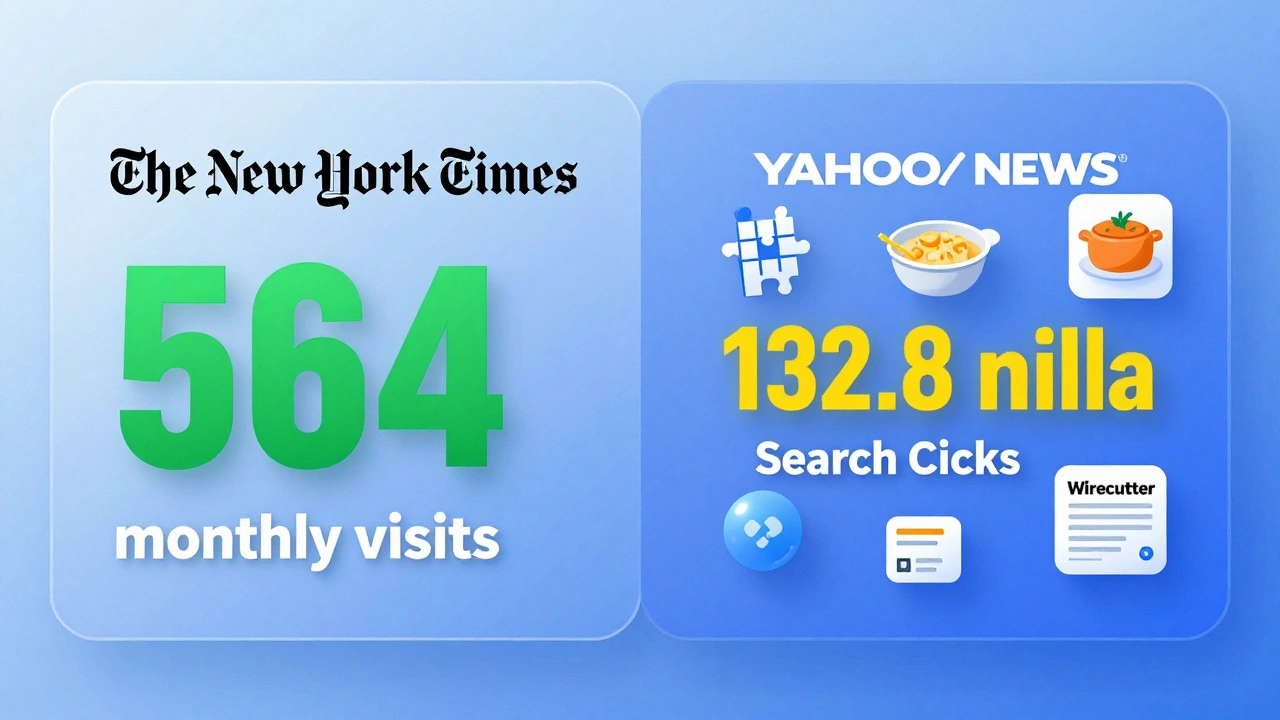
In 2025, The New York Times (nytimes.com) pulled in 564 million monthly visits in the U.S., according to PRLab’s May data. That’s more than CNN’s 434 million and Fox News’ 206 million. Statista’s December 2024 numbers show a similar gap: 463 million for NYT, 357 million for CNN. This isn’t a fluke. The Times has held the top spot for years, even as other outlets struggled with declining ad revenue and shifting habits.
What’s driving those numbers? It’s not just breaking news. People return to the Times for its depth - long-form investigations, climate reports, business analysis, and even its crossword puzzle, which draws 5 million daily players. The cooking section has 3.5 million subscribers. Wirecutter, bought for $30 million in 2016, brings in shoppers looking for trusted product reviews. These aren’t side projects. They’re retention engines.
But What About Search Traffic?
Here’s where things get messy. If you look at organic search traffic - the clicks people get from Google - Yahoo News leads. Ahrefs’ October 2025 data shows Yahoo with 132.8 million search visits, compared to The New York Times’ 110 million. SimilarWeb also ranks Yahoo first in the broader "News & Media Publishers" category.
Why? Yahoo News is a news aggregator. It doesn’t produce original reporting. It pulls headlines from CNN, AP, Reuters, and yes, The New York Times. So when someone searches for "election results" or "stock market today," Yahoo surfaces the top stories from across the web. That’s why its traffic is high - but it’s not the same as reading the Times’ own reporting.
Most experts agree: if you’re asking who produces the most-read original journalism in the U.S., the answer is The New York Times. If you’re asking who gets the most clicks from search engines, Yahoo wins. Two different metrics. Two different stories.
Why Does the New York Times Keep Winning?
The Times didn’t get here by accident. In 2011, it launched its paywall - a bold move when most news sites were giving content away for free. Today, it has 10.3 million digital-only subscribers. That’s more than the next two largest U.S. newsrooms combined: The Washington Post and The Wall Street Journal.
Its business model is simple: charge for quality. In 2024, 83% of its revenue came from subscriptions. Compare that to Yahoo News, which gets 92% of its income from ads. That difference shapes everything. The Times doesn’t need to chase clicks with sensational headlines. It can afford to publish slow, deep stories - like its 2024 investigation into private prison labor, which won a Pulitzer.
Behind the scenes, the tech is impressive. The Times runs on a custom system called Project Feeder, hosted on AWS. It handles 1.2 billion page views daily with a 95ms average load time. The iOS app has a 4.8/5 rating from over 187,000 reviews. The Android app isn’t far behind at 4.5/5. That’s not luck. It’s investment.

Who’s Challenging the Throne?
Not many are catching up - but some are growing fast. Forbes saw a 42.7% year-over-year traffic spike. People magazine grew 32.3%. These aren’t legacy newsrooms. They’re digital-native brands built for social sharing and algorithm-friendly content.
Then there’s YouTube. SEMrush lists it as the top "Newspaper" site with 6.15 billion visits. But that’s misleading. YouTube isn’t a news website - it’s a video platform where news outlets post clips. The Times has its own YouTube channel, but it doesn’t compete with YouTube. It uses it.
And then there’s TikTok. Pew Research found 31% of 18- to 29-year-olds now get news from TikTok. That’s higher than The New York Times’ 17% among the same group. Younger audiences aren’t abandoning news - they’re abandoning traditional formats. That’s why the Times launched NYT Today in May 2025: a free app with 60-second news briefs. It got 4.2 million downloads in its first month. Critics say it’s "dumbing down journalism." Supporters say it’s survival.
Trust Is the Real Metric
Here’s something most traffic numbers miss: trust. YouGov’s October 2025 survey found that 58% of Americans trust The New York Times - the highest of any major news brand. The industry average? 34%. CNN sits at 41%. Fox News? 39%. Yahoo News? Just 29%.
That trust comes at a cost. The Times’ audience is mostly college-educated (78%), over 55 (31%), and earns over $100,000 a year (63%). Only 12% of readers identify as Hispanic. 8% are Black. Critics say the Times speaks to an elite audience. Professor Nic Newman from Oxford calls its subscription model "a sustainable quality journalism ecosystem." Emily Bell from Columbia Journalism School calls it "elitist," pointing out that only 22% of high school-educated Americans trust it.
It’s not that the Times ignores diversity. It’s that its business model doesn’t reward volume. It rewards loyalty. And loyalty comes from consistency - not virality.

The Paywall Problem
Subscribers love the ad-free experience. But the Times cracked down on password sharing in January 2025. Before that, each account was shared by 3.2 people on average. After? Down to 1.7. That’s a 47% drop in household usage.
It’s a smart move for revenue - but a risky one for reach. Reddit threads are full of complaints: "I can’t share my account with my mom." "I used to read it at work, now I can’t." Trustpilot ratings show 25% of reviews are negative, mostly over paywall frustration.
Still, the numbers hold. The Times’ digital growth outpaced the industry. In 2024, U.S. digital news revenue hit $14.3 billion - up 37% since 2020. The Times took 28% of all digital subscriptions. That’s more than double its closest competitor.
Final Answer: Who’s the Most Read?
If "most read" means total monthly visits to an original news site - The New York Times wins. By a lot.
If "most read" means search traffic - Yahoo News leads, but it’s a mirror, not a source.
If "most read" means trusted, consistent, and deeply reported journalism - The New York Times is unmatched. It has 132 Pulitzer Prizes. No other outlet comes close.
The real question isn’t who gets the most clicks. It’s who’s keeping real journalism alive in a world that rewards speed over substance. Right now, the answer is still The New York Times.



About Author
