What Are the Other Political Parties Besides Democrat and Republican?
Most people in the U.S. think politics is just Democrats and Republicans. But that’s not the whole story. Behind the big two, there are other parties trying to make a difference-some with real voters, real campaigns, and real impact. They don’t win many elections, but they change the conversation. And sometimes, they force the big parties to listen.
Who Are the Main Third Parties?
The largest third party in the U.S. is the Libertarian Party. As of 2024, it had over 704,000 registered voters across the country. That’s less than half a percent of all registered voters, but it’s more than any other alternative party. Libertarians believe in minimal government-lower taxes, fewer regulations, and more personal freedom. They oppose most federal programs, including the War on Drugs and foreign military interventions. In 2020, their presidential candidate got about 1.2% of the vote. Not much, but enough to show there’s a consistent base.
The Green Party is the second-largest third party, with around 249,000 registered voters. Their focus is on climate change, social justice, and nonviolence. They push for 100% renewable energy, universal healthcare, and criminal justice reform. In 2000, their candidate Ralph Nader got 2.7% of the vote-a number some analysts say helped Al Gore lose to George W. Bush. Since then, the Green Party has shifted strategy: instead of chasing the presidency, they focus on local races. In a few states, they’ve won city council seats and school board positions by running candidates who appeal to voters tired of both major parties.
Then there’s No Labels. It’s not a traditional party. It’s a movement. Started by centrist Democrats and Republicans who think both sides have gone too far, No Labels wanted to run a moderate presidential candidate in 2024. They raised money, gathered signatures, and even polled voters. But they couldn’t get on enough ballots. By April 2024, they gave up. Still, they have nearly 110,000 registered members. Their real power isn’t in winning-it’s in pressuring both parties to act more like moderates.
Why Don’t Third Parties Win?
It’s not that people don’t want them. In 2024, 58% of Americans said they believe a third major party is needed. But the system is stacked against them.
The biggest problem? Winner-take-all elections. In most U.S. races, the person with the most votes wins-even if they only get 35%. If you’re a third-party candidate and you get 20%, you get nothing. No seat. No influence. Just a footnote in the news. That’s why most voters avoid them. They don’t want to “waste” their vote.
The Electoral College makes it even harder. To win the presidency, you need 270 electoral votes. But electors are bound to vote for their party’s nominee. Even if a third-party candidate wins 30% of the popular vote, they won’t get a single elector unless they win a state outright. That’s nearly impossible without massive funding and infrastructure.
Ballot access is another nightmare. To get on the ballot in all 50 states, a third-party candidate needs about 2 million valid signatures. Each state has different rules. In California, you need 178,500 signatures just to qualify. In Alabama, you need a petition signed by 3% of the last gubernatorial vote. And you have to do it all before deadlines that often fall months before the election. Most third parties can’t afford the lawyers or staff to handle it.
Debates are another wall. The Commission on Presidential Debates only lets candidates in if they hit 15% in five national polls. That’s a high bar. No third-party candidate has cleared it since Ross Perot in 1992. And without debate exposure, most voters don’t even know who they are.
How Do Third Parties Even Survive?
They don’t try to win the presidency. They win local races.
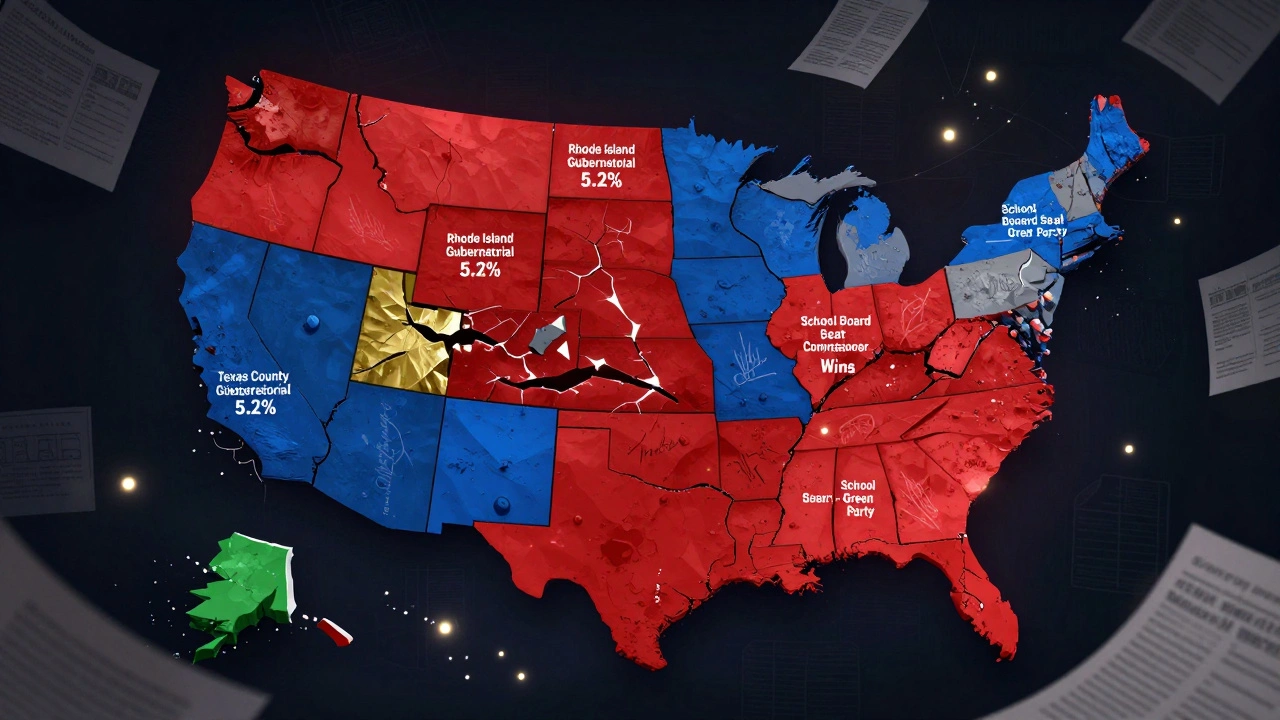
The Libertarian Party has quietly built a base in rural Texas. Since 2018, they’ve won 12 county commissioner seats. These aren’t glamorous jobs, but they control zoning, budgets, and local law enforcement. In places where voters are fed up with both Democrats and Republicans, Libertarians show up with a simple message: “Let us manage this town without state interference.” It works.
In Rhode Island, the Moderate Party got 5.2% of the gubernatorial vote in 2022-the highest for any third-party candidate in a statewide race since 2016. They didn’t win, but they forced both major parties to talk about fiscal responsibility and education reform. That’s the real win.
Some third parties don’t run candidates at all. They just push issues. The Green Party’s climate platform is now part of the Democratic Party’s official agenda. The Libertarian Party’s stance on surveillance and privacy influenced parts of the 2020 police reform debate. Even if they lose, they shift the Overton window-the range of ideas considered acceptable in politics.
What About Ross Perot and Elon Musk?
Ross Perot ran as an independent in 1992 and got 19% of the popular vote-the highest ever for a third-party candidate in modern times. He didn’t win a single state, but he made deficit reduction a national issue. Both major parties changed their platforms because of him.
Now, Elon Musk has hinted at starting a new party called the “America Party.” He’s talked about fixing the economy, reducing bureaucracy, and ending partisan gridlock. But Musk isn’t running for office. He’s not even registered as a party organizer. His influence is in money and attention. If he spends millions on ads or pushes for ballot access in key states, he could give a third party a real shot. But history says it won’t be easy. Even with billions, changing the system takes more than money-it takes organization, patience, and a long game.
Why Do People Still Support Them?
Because they’re tired.
Independent voters-people who don’t identify with either major party-make up 42% of the electorate. And 69% of them say they want a third party. That’s not a small group. It’s 1 in 2 voters.
On Reddit, one user wrote: “I registered Libertarian in 2016 thinking it would pressure Republicans on civil liberties. Instead, it just helped Trump win.” That’s the fear. Voting third party feels like helping the worse option.
But others say: “Our Green Party chapter got 17% in our state race. Suddenly, both Democrats and Republicans had to talk about climate change in the debates.” That’s power. Not winning. But forcing change.
There’s also a generational shift. Younger voters are less loyal to parties. They care about issues-climate, student debt, mental health, AI regulation. Neither major party fully represents them. So they look elsewhere.
Is There Hope for Change?
Yes-but not from the top. It comes from the bottom.
Real change happens when third parties win local offices. When they build community support. When they prove they can govern-even on a small scale. That’s how the Republican Party started in the 1850s. It wasn’t a national movement at first. It was a coalition of anti-slavery activists, former Whigs, and free-soilers who won town meetings and state legislatures before taking over the White House.
Today, the same thing could happen. A new party doesn’t need to win the presidency to matter. It just needs to win one county. One city council. One school board. Then another. And another.
The system is designed to resist change. But it’s not impossible. History shows that when enough people are fed up, the walls start to crack. The question isn’t whether third parties can win. It’s whether enough voters are willing to risk voting for them-just once-to see what happens.

About Author
