Which US City Is Bigger Than London? The Real Answer Explained
City Size Comparison Calculator
London vs. New York City Population Comparison
See how different measurement methods change the answer
Population Comparison
London
New York City
- City Limits: Official administrative boundaries (e.g., London's Greater London or NYC's 5 boroughs)
- Metro Area: The functional urban region where people live, work, and commute
People often say New York City is bigger than London. But if you look at the numbers, that’s not quite right - at least not the way most think. The truth is messy, and it depends on what you mean by "bigger." Are you talking about the city limits? The whole metro area? The number of people living and working there every day? The answer changes completely based on how you measure it.
London’s City Proper Is Still Larger Than New York’s
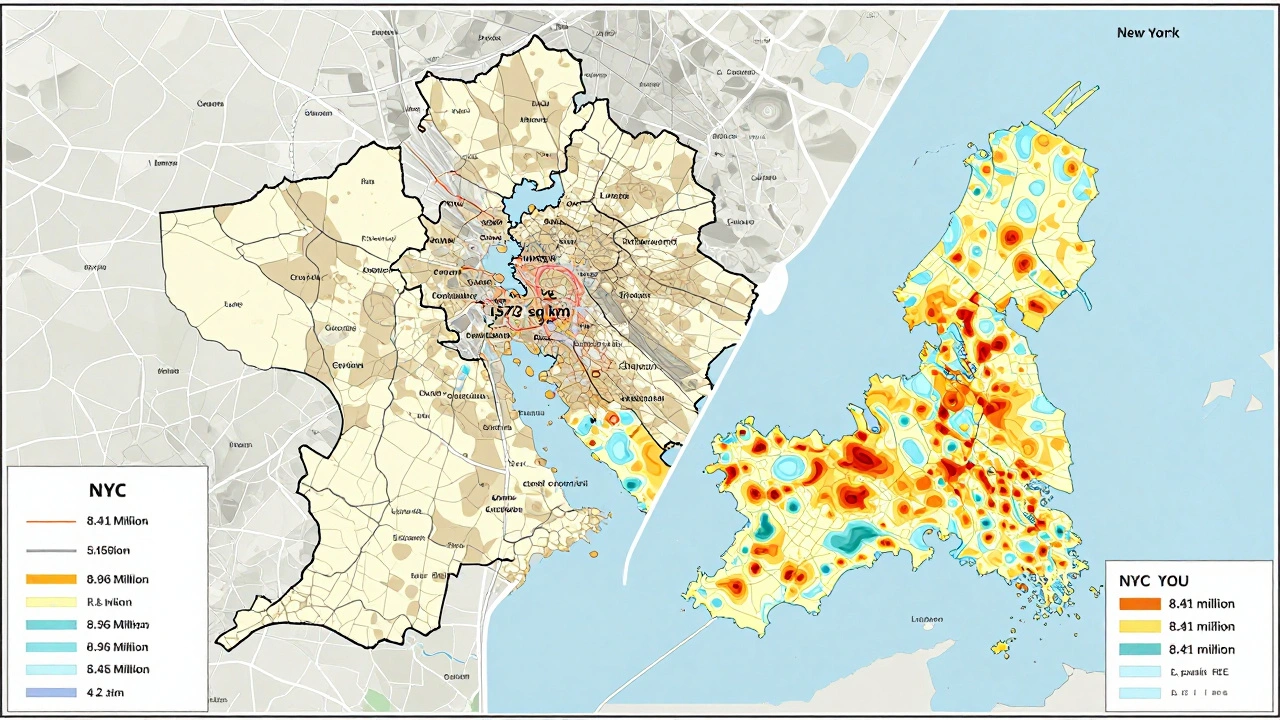
By official city boundaries, London wins. Greater London, the administrative area governed by the Mayor and City Hall, had about 8.96 million residents in mid-2023, according to the UK’s Office for National Statistics. New York City, which includes only the five boroughs - Manhattan, Brooklyn, Queens, the Bronx, and Staten Island - had 8.41 million people in 2024, per the U.S. Census Bureau. That’s a difference of over half a million people. So if you’re counting only what’s inside each city’s legal border, London is bigger.
Why does this happen? It’s because London’s city limits are huge. Greater London covers 1,572 square kilometers and includes places like Croydon, Enfield, and Bromley - areas that in the U.S. would be separate cities or suburbs. In contrast, New York City’s boundaries haven’t changed much since the early 1900s. It doesn’t include places like Long Island, Newark, or Yonkers, even though millions live there and commute into Manhattan daily.
But New York’s Metro Area Is Way Bigger
Here’s where things flip. If you look at the entire region where people live, work, and travel - the functional urban area - New York crushes London. The New York-Newark-Jersey City Metropolitan Statistical Area (MSA) had an estimated 19.6 million people in 2025, according to U.S. Census projections. That’s nearly 5.5 million more than Greater London’s functional urban area, which sits at about 14.26 million.
This isn’t just a numbers game. It’s about how the two cities are structured. London operates like one big city with one mayor and one government overseeing the entire area. New York is part of a sprawling, fragmented region with over 1,500 separate towns and cities across three states. There’s no single government for the whole metro area. But economically and socially, it all functions as one unit.
Why This Confusion Exists
Most Americans think of New York City as just Manhattan. But Manhattan only has about 1.6 million people - less than a fifth of London’s population. That’s why you see headlines saying "Manhattan is bigger than London" - and they’re wildly wrong. Even Brooklyn, the most populous borough, has fewer people than Tower Hamlets, one of London’s densest boroughs.
On the other side, many Brits assume New York City means the whole metro area. When they hear "New York has 20 million people," they think it’s the city. But in the U.S., that number is always the metro area unless specified otherwise. This mismatch in language and definition causes endless confusion.
Experts call this the "boundary problem." The Brookings Institution found that U.S. city limits cover only about 11% of their metro populations. In London, the city proper covers nearly 80% of its functional urban area. So comparing them directly is like comparing apples to orange trees.

Other U.S. Cities? None Come Close
Is there any other U.S. city that’s bigger than London? Not even close. Los Angeles city proper has under 4 million people. Chicago? About 2.7 million. Dallas? Less than 1.3 million. Even their metro areas don’t beat London’s - LA’s metro has 18.6 million, which is close, but still under New York’s. Chicago’s metro is around 9.5 million - less than two-thirds of London’s functional area.
Only New York’s metro area surpasses London’s in population. And even then, it’s not even close to the next tier. The entire Northeast Megalopolis - from Boston to Washington, D.C. - has over 40 million people. But that’s not a single city. It’s a chain of connected urban zones.
It’s Not Just About People
Population isn’t the only way to measure size. Economic output? New York’s GDP hit $1.8 trillion in 2025, beating London’s $1.1 trillion. But London still leads in global financial influence, ranking slightly higher in the Global Financial Centres Index. Air traffic? London’s six airports handled 178 million passengers in 2025. New York’s five airports managed 142 million. So while New York has more people in its region, London moves more people in and out.
Even housing costs tell a story. London’s average home price is 8.5 times the median income. New York’s is 7.2 times. Both are unaffordable, but London’s pressure is slightly worse. Meanwhile, New York’s metro area is growing faster - adding over 87,000 people in 2024 alone - while London’s growth slowed to just 24,000.

What Should You Believe?
So which city is bigger? If you’re looking at maps, city limits, or local government services - London wins. If you’re thinking about the real, living, working, commuting urban region - New York’s metro area is the giant.
For tourists? City proper numbers matter. London & Partners promotes 9 million residents. NYC & Company promotes 8.4 million. For investors? They care about the metro. The New York-New Jersey Economic Development Council markets a 20 million-person market. London & Partners talks about 14.3 million.
For researchers? They use Functional Urban Areas (FUAs), the OECD’s standardized method. In that system, New York’s FUA is 19.8 million. London’s is 14.1 million. So again - New York wins, but only when you use the right tool.
Why This Matters
This isn’t just trivia. It affects policy, funding, and planning. If a city planner in Chicago compares their transit system to London’s using city proper numbers, they’ll get the wrong idea. If a startup chooses a location based on "city size" without knowing the difference between city limits and metro area, they could pick the wrong place.
The takeaway? Always ask: "What do you mean by bigger?" Population? Area? Economy? Influence? The answer changes everything. And in the case of New York and London, both cities are massive - just in different ways. One is a single, dense, tightly governed unit. The other is a sprawling, decentralized powerhouse. Neither is "better." But if you’re trying to understand which is larger, you need to pick your metric - or you’ll be wrong.
Is New York City bigger than London?
It depends. By city limits, London is bigger - 8.96 million vs. 8.41 million. But by metropolitan area, New York is much bigger - 19.6 million vs. 14.26 million. Neither answer is wrong. You just need to know what you’re measuring.
What’s the population of Greater London?
As of mid-2023, Greater London had 8,961,989 residents. This includes all 32 boroughs and the City of London. It’s the official administrative boundary used by the UK government.
Why is New York’s metro area so much bigger than London’s?
New York’s metro area includes parts of three states - New York, New Jersey, and Pennsylvania - with dozens of independent cities and towns that are economically tied to Manhattan. London’s functional area is more compact and contained within one administrative region. The U.S. has a history of decentralized governance, while London has been unified under one authority since 1965.
Is Manhattan bigger than London?
No. Manhattan has about 1.6 million people. Greater London has nearly 9 million. Some viral posts claim Manhattan is bigger, but they’re confusing the borough with the whole city. Manhattan is just one part of New York City - and far smaller than London.
Which U.S. city has the largest metro area?
New York-Newark-Jersey City is the largest by far, with nearly 20 million people. Los Angeles comes second at 18.6 million, followed by Chicago at 9.5 million. No other U.S. metro area comes close to New York’s scale.
Does London’s population include suburbs?
Yes - but only the ones inside Greater London’s official boundary. Places like Croydon, Sutton, and Barnet are legally part of London and counted in its 8.96 million. But areas like Reading or Brighton, which many people commute from, are not included - even though they’re functionally part of the wider London region.
How do experts compare cities across countries?
The OECD and World Bank recommend using Functional Urban Areas (FUAs), which measure continuous built-up zones with high economic integration. Using this method, New York’s FUA is 19.8 million and London’s is 14.1 million. This avoids the distortion caused by arbitrary city boundaries.



About Author
