
Who Runs the British? The Real Power Behind the UK Government in 2025
Power Balance Calculator
Input Key Factors
Adjust these values to see how they affect UK governance stability
Weak
Strong
Results
Power Balance Score
0%
How this works: Based on factors mentioned in the article including parliamentary stability, civil service capacity, devolution strength, and public trust levels.
Warning: Low scores indicate potential governance instability as described in the article.
The question who runs the British isn’t about who holds the crown-it’s about who makes the decisions that shape daily life in the UK. On paper, the monarch is head of state. In reality, the country is run by a small group of politicians, civil servants, and institutional structures that operate out of sight, yet control everything from your NHS appointment to your train ticket price.
The Prime Minister and the Cabinet
Since July 5, 2024, Keir Starmer has been the person with the most direct power in the UK. As leader of the Labour Party, which won a landslide victory in the 2024 general election, he became Prime Minister and now leads His Majesty’s Government. Starmer isn’t just a figurehead-he controls the Cabinet, appoints ministers, sets the national agenda, and answers to Parliament for every major decision. His Cabinet, now made up of 22 senior ministers after a reshuffle in September 2025, includes key figures like Rachel Reeves as Chancellor of the Exchequer and Yvette Cooper as Home Secretary. These are the people who decide how much money goes to schools, how immigration rules are enforced, and whether public services get more funding or cuts. Unlike in the U.S., where the president is separate from Congress, the UK system ties the executive directly to Parliament. Starmer’s government only stays in power as long as it has the support of a majority in the House of Commons. With 412 Labour MPs out of 650, he currently has that majority-but it’s not guaranteed. Backbench rebellions have already surfaced, especially around welfare reform and public sector pay deals.The Civil Service: The Permanent Government
While ministers change with elections, the civil service stays. It’s the hidden engine of British governance. Around 492,000 full-time staff work across departments like the Treasury, Home Office, and Department for Health. These aren’t politicians-they’re career officials who draft laws, manage budgets, and implement policies. Chris Wormald, the Cabinet Secretary since August 2024, is the top civil servant. He doesn’t get elected. He doesn’t give speeches. But he advises the Prime Minister, coordinates between departments, and ensures the machinery of government keeps running-even when ministers change their minds. In April 2025, the Cabinet Office, which acts as the central hub for government operations, cut 2,100 jobs. That wasn’t just cost-cutting-it was a structural overhaul. Functions were moved out of Whitehall and into smaller, more focused units. The goal? To stop the bureaucracy from slowing down decisions.Parliament: The Check, Not the Commander
The UK Parliament has two houses: the elected House of Commons and the appointed House of Lords. The Commons is where real power lies. It’s where laws are debated, amended, and passed. The Lords can delay legislation, but they can’t block it permanently. After the 2024 election, over half of MPs were new. That means many aren’t yet fluent in the complex rules of parliamentary procedure. This has led to delays on key bills, especially those that require technical expertise-like the new National Wealth Fund or the plan to renationalize railways. Labour’s first major legislative win came on May 25, 2025, when South Western Railway officially returned to public ownership. It was a symbolic move, but it showed how quickly the government could act when it had a clear mandate and a disciplined party line. Still, Parliament is under strain. Voter trust is at an all-time low. Only 28% of Britons say they trust government institutions, down from 41% in 2020. Many feel MPs are out of touch. A YouGov survey in autumn 2025 found that 53% of people now prefer a coalition government over single-party rule-a dramatic shift from the traditional two-party system.
The Real Players: Who’s Influencing Decisions Behind the Scenes?
Power doesn’t just sit in Westminster. It’s also in boardrooms, think tanks, and lobbying offices. Reform UK, though not in government, is shaping the political conversation. A 2025 NatCen poll found that 35% of voters believe Reform UK will be the largest party after the next election-even though 58% associate them with extreme views. Their focus on immigration and anti-establishment rhetoric has forced Labour and the Conservatives to adjust their messaging. Meanwhile, big corporations and industry groups have direct access to ministers. Former Conservative minister Penny Mordaunt, now on the advisory board of British American Tobacco, represents how the revolving door between politics and private interests continues. The Office for Budget Responsibility (OBR) also plays a crucial role. It’s an independent body that assesses the government’s economic plans. In Budget 2025, the OBR warned that the UK’s fiscal consolidation plan-aimed at cutting deficits-is the most aggressive in the G7 over the next five years. That means more austerity, more pressure on public services, and more political risk for Starmer.Local Power: Devolution and the Fight for Control
The UK isn’t just run from London. Power is slowly shifting to regions. Wales, Scotland, and Northern Ireland have their own parliaments or assemblies with control over health, education, and transport. In January 2025, Wales’ First Minister Eluned Morgan pushed the UK government to give the Welsh Government control over the Crown Estate in Wales-a move that would let Wales keep billions in revenue from offshore wind farms instead of sending it to Westminster. At the same time, local councils are being stripped of power. The government plans to cut 5,600 councillor positions over five years to save £250 million. Critics say this weakens local democracy. Supporters argue it cuts waste. The result? A fragmented system. People in Manchester, Cardiff, and Glasgow have different experiences of government than those in London. Who runs the British? It depends on where you live.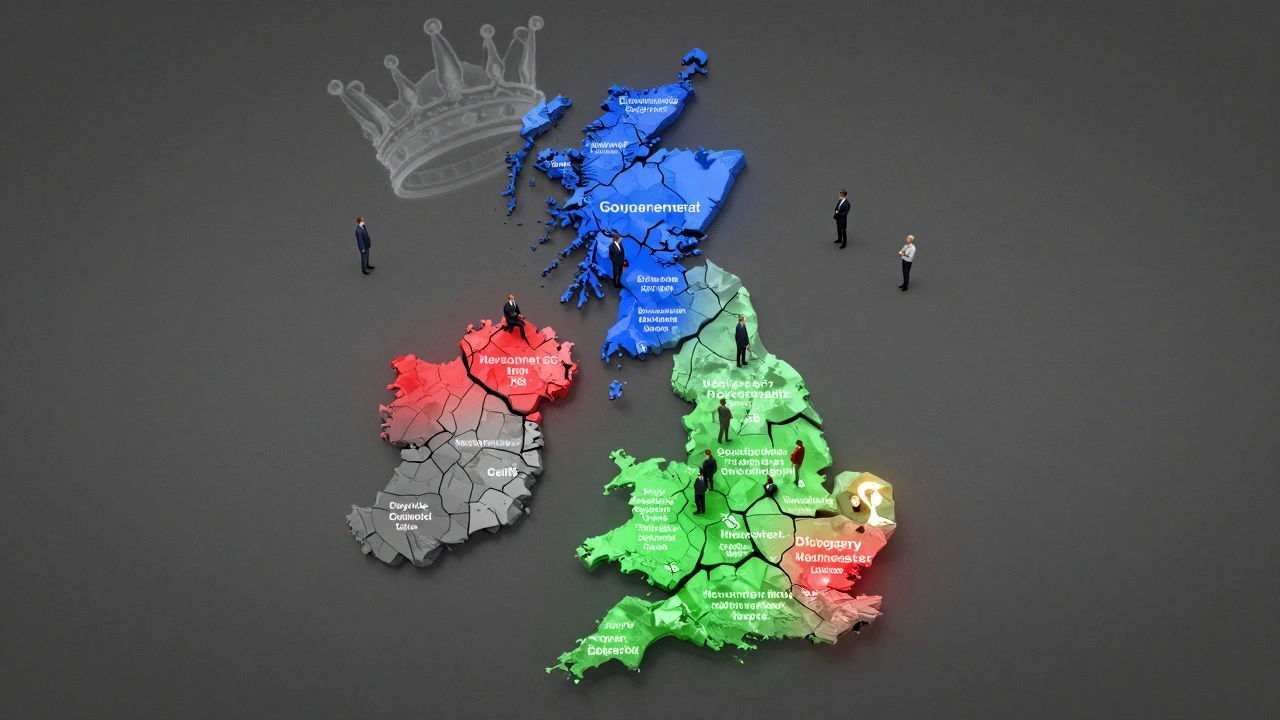
Public Trust: The Biggest Challenge
The biggest question isn’t who holds office-it’s whether anyone still believes the system works. In 2025, the UK scored 83 out of 100 on Freedom House’s democratic freedoms index. That’s solid-but it’s not enough. Trust is collapsing. Voter turnout in 2024 was the highest in a decade, but that was fueled by anger, not confidence. The Labour government’s five missions-fixing the economy, building clean energy, reforming public services, creating a National Wealth Fund, and restoring trust-are ambitious. But they’re also risky. If they fail, the backlash could be severe. Reddit threads like the one on r/ukpolitics show the divide. One user says Starmer’s reshuffle prioritized loyalty over expertise. Another says, “At least there’s actual policy substance now.” The truth? No single person runs the British. It’s a system-flawed, outdated, but still functional. And right now, it’s being tested like never before.What Comes Next?
The next two years will decide whether Labour’s government can deliver on its promises-or if Britain’s political system fractures further. The Plan for Change, a 100-day, one-year, and five-year roadmap, is being closely watched. If the government hits its targets-like building 170,000 new homes or cutting business red tape by £5.6 billion-it could restore some faith in politics. If it doesn’t? Expect more protests, more support for Reform UK, and more calls for electoral reform. The old two-party system is dying. What replaces it is still being written. The British aren’t run by one person. They’re run by a fragile balance of power-between politicians and bureaucrats, between London and the regions, between promises and results. And that balance is tipping.


About Author
