Where Do Most Americans Get Their News in 2025?
Social Media News Usage Calculator
News Consumption by Age Group
See how social media usage for news varies across different age groups in 2025.
Select an age group to see the percentage of Americans who get news from social media at least sometimes.
By 2025, the way Americans get their news has changed more in the last decade than it did in the 50 years before. It’s no longer about turning on the TV at 6 p.m. or picking up a newspaper on the porch. The real story isn’t which outlets are still around-it’s where people are actually looking, and why.
Social Media Is Now the Top News Source
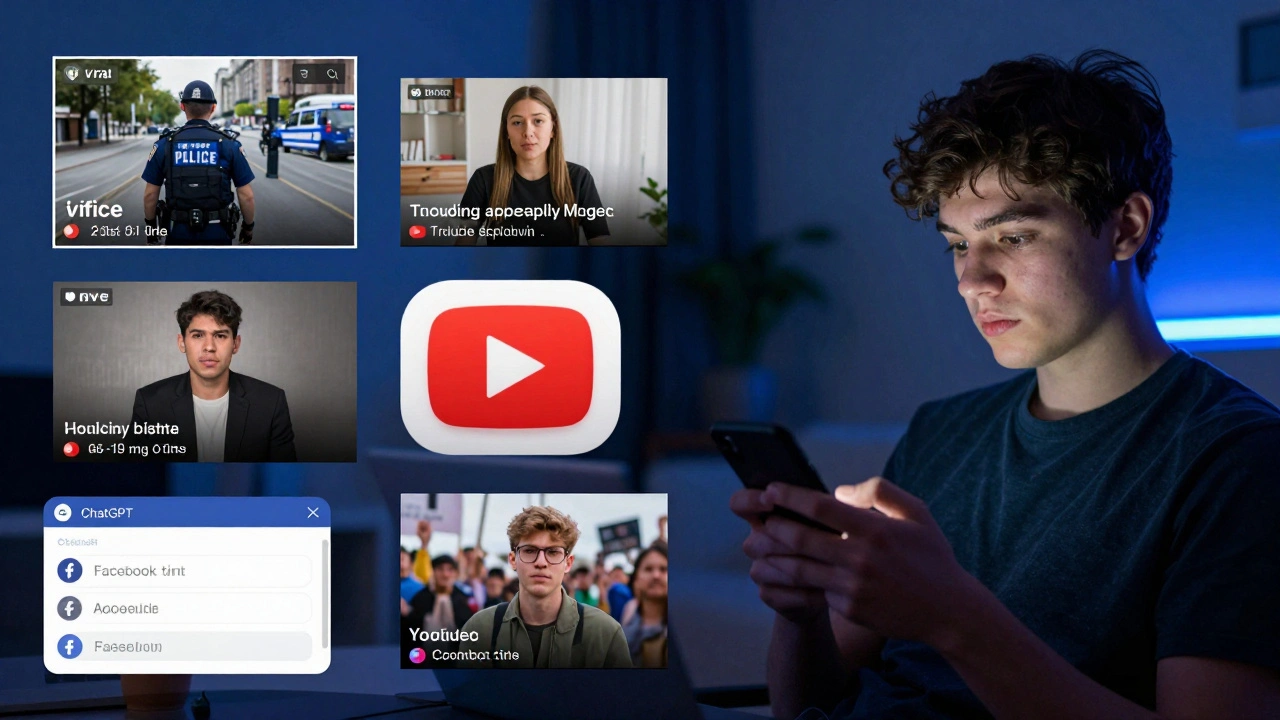
More Americans get their news from Facebook and YouTube than from any single TV network or newspaper. In 2025, social media edged out television and news websites as the primary way people find breaking stories. About 34% of U.S. adults say they use social media as their main news source, up from just 4% in 2015. Even more-53%-say they get news from social media at least sometimes, according to Pew Research Center.
Facebook leads with 44% of Americans reporting they’ve seen news there in the past month. YouTube isn’t far behind at 41%. These aren’t just places people scroll through memes-they’re where news spreads fastest. A viral clip from a live stream, a tweet with a breaking update, or a TikTok video explaining a policy change often reaches more people than a headline on CNN or Fox News.
Younger Americans are driving this shift. Among those aged 18 to 29, 76% get news from social media at least sometimes. That’s 48 percentage points higher than Americans 65 and older, who only make up 28% of social media news users. For Gen Z and younger millennials, influencers and creators are as trusted as traditional journalists. About 39% of adults under 30 say they regularly get news from influencers-not reporters.
Traditional Media Is Still Around, But Losing Ground
That doesn’t mean newspapers and TV are gone. They’re just no longer the main source. Fox News and CNN still rank as the most-mentioned traditional outlets, with 40% and 36% of Americans saying they’ve gotten news from them in the past month. But even those numbers are misleading. A lot of that news is coming from clips shared on YouTube or Facebook, not from people tuning in live.
Print newspapers are hanging on by a thread. Only 13% of Americans used a print paper in the past month. That number drops to 10% for those under 45. The New York Times still leads print with 24% monthly usage, but most of that comes from older readers. Younger people rarely touch paper.
Radio still reaches 29% of Americans, mostly during commutes or at work. News apps also hit 29%, and search engines like Google pull in 28%. But these are mostly fallbacks-people looking for something specific, not scanning for headlines.
Word of Mouth Is Still Powerful
Here’s something you might not expect: 45% of Americans say they heard about a news story from a friend, family member, or coworker in the past month. That’s more than the number who read a print newspaper. It’s not just gossip-it’s how information travels in real life. Someone shares a link on WhatsApp, a coworker mentions a TikTok video at lunch, or a parent tells their kid about a new law they saw on Instagram. These informal networks are now a major part of the news pipeline.
WhatsApp, in particular, is growing fast among Black, Hispanic, and Asian American communities. It’s not just a messaging app-it’s a news hub. People forward videos, screenshots, and articles without checking sources. That’s why misinformation spreads so easily.
AI Is the New Wild Card
By 2025, AI chatbots are quietly becoming a news source. Eight percent of Americans say they’ve gotten news from ChatGPT in the past month. That number jumps to 14% for adults under 45. Twice as many people use ChatGPT for news as any other AI tool.
Why? Because it’s fast. Instead of scrolling through five articles, you ask, “What happened in the latest election?” and get a summary in seconds. It’s not perfect-AI can make things up-but for quick context, it’s becoming a habit. Younger users especially like it because it feels personal, like talking to someone who knows the answer.
It’s not just ChatGPT. Podcasters are growing too. People listen while driving or working out. One in five Americans now listens to a news podcast monthly. These aren’t long-form interviews-they’re 10-minute updates that fit into a busy day.
Trust Is Broken, Especially Among Younger Groups
Even as people turn to new sources, trust in the media keeps falling. Only 28% of Americans now say they trust newspapers, TV, or radio to report accurately. That’s the lowest ever recorded. The divide is sharp: 43% of Americans 65 and older trust the media, but only 28% of those under 65 do. Among Republicans, trust is as low as 6% in some age groups. Democrats trust it more, but still less than half the time.
Younger Americans don’t trust traditional media because they’ve seen it get things wrong-over and over. They’ve watched live events unfold on TikTok before the news channels reported them. They’ve seen headlines twisted for clicks. So they turn to sources that feel more real: a friend’s video, a creator they follow, or an AI that answers directly.

Who’s Getting News Where? The Demographic Divide
It’s not just about age. Race, education, and politics shape where people look.
- Black, Hispanic, and Asian Americans are more likely to get news from YouTube, Instagram, and WhatsApp than White Americans.
- People without a college degree rely more on Facebook and TikTok for news.
- Democrats are more likely to use Instagram, TikTok, and Reddit; Republicans use YouTube just as much, but less of the others.
- College grads get more news from search engines and news apps; non-grads get it from social media posts and word of mouth.
And here’s the kicker: only 15% of young adults say they follow the news “all or most of the time.” That’s compared to 62% of those 65 and older. Younger people aren’t disengaged-they’re just not consuming news the old way. They get snippets, not deep dives. They care about what affects them-housing, jobs, climate, school-more than political debates.
What This Means for the Future
The news landscape in 2025 isn’t just different-it’s fractured. There’s no single source anymore. No one channel controls the narrative. News flows through TikTok, WhatsApp, YouTube, and AI chatbots. It’s faster, messier, and harder to control.
The biggest risk? Misinformation. The World Economic Forum named it the top short-term global risk in 2025. False claims spread faster than facts. A video edited to look real can go viral before a fact-checker even sees it. And with fewer people trusting traditional outlets, there’s less of a trusted anchor to correct the record.
For now, Americans are adapting. They’re learning to check sources. They’re asking friends: “Did you see this too?” They’re using AI to cross-check facts. But the system is still fragile. The real challenge isn’t finding news-it’s knowing what to believe.
Do most Americans still watch TV for news?
No. While TV news still reaches a large audience, it’s no longer the top source. Social media and video platforms like YouTube have overtaken TV for the first time in 2025. Only about 30% of Americans say they regularly get news from TV, and that number is falling fast among younger viewers.
Is ChatGPT a reliable news source?
Not reliably. While 8% of Americans use ChatGPT for news, it doesn’t fact-check itself. It can invent details, mix up dates, or give outdated info. It’s useful for quick summaries or understanding context, but never as a sole source. Always cross-check with a trusted outlet if accuracy matters.
Why are younger people turning away from traditional news?
They see traditional media as slow, biased, or out of touch. Younger Americans grew up with instant updates on their phones. They trust people they follow online more than anchors on TV. They also don’t trust the motives behind corporate-owned news outlets. Social media and influencers feel more direct and real to them.
Which social media platform is most trusted for news?
No platform is widely trusted. YouTube is the most used, but not the most trusted. People use it because it’s accessible and has long-form content. Instagram and TikTok are popular for quick updates, but misinformation spreads fast there too. Trust isn’t about the platform-it’s about who you follow. A verified journalist with a large following is more trusted than a random account, even on the same app.
Are print newspapers dead?
Not dead, but nearly irrelevant for most Americans. Only 13% used a print paper in the past month. The New York Times is the last major holdout, but even its print readers are mostly over 50. For younger people, print is a relic-not a source.
How do I know if a news story I see online is real?
Check three things: Who posted it? Is it a known outlet or a random account? Where else is it reported? If only one TikTok video or Facebook post mentions it, be skeptical. Look for the same story on a site like Reuters, AP, or NPR. And don’t trust headlines alone-read the full article. If it’s too emotional or extreme, it’s likely designed to go viral, not inform.
About Author
