
What is the biggest international news today? IMF revises global growth forecast amid AI boom and trade risks
The biggest international news today isn't a war, a coup, or a natural disaster. It's a number: 3.3 percent. That’s the International Monetary Fund’s revised forecast for global economic growth in 2026 - up from 3.1 percent just four months ago. This isn’t just another update in a long string of economic reports. It’s the most consequential shift in global economic expectations since the pandemic, and it’s sending ripples through markets, central banks, and trade negotiations from Washington to Brussels to Beijing.
Why this forecast matters more than most
The IMF doesn’t just guess at growth numbers. Its World Economic Outlook is the global benchmark. Central banks use it to decide whether to raise or cut interest rates. Governments use it to plan budgets. Investors use it to allocate trillions in assets. When the IMF revises its forecast upward, it’s not just being optimistic - it’s saying the underlying economy is changing in a real, measurable way. This time, the change is driven by one thing: artificial intelligence. Not science fiction. Not future potential. Real, current investment. The IMF now estimates that AI infrastructure spending contributed nearly 0.3 percentage points to U.S. GDP growth in the first three quarters of 2025. That’s the equivalent of adding a small but powerful engine to the global economy. Tech companies are building data centers faster than power grids can keep up. Financial firms are deploying AI to automate trading. Manufacturers are using AI to cut waste and boost output. These aren’t experiments. They’re operational shifts.The U.S. is pulling ahead - but not everyone is
The U.S. is the clear winner in this new chapter. Its 2026 growth forecast was upgraded to 2.4 percent, the biggest lift among major economies. That’s thanks almost entirely to tech investment. Even after a months-long government shutdown in late 2025, the economy didn’t just recover - it accelerated. The IMF’s chief economist, Pierre-Olivier Gourinchas, called this a "tailwind from the AI and tech investment boom." But look closer, and the picture gets uneven. The euro area’s growth forecast stayed stuck at 1.3 percent. Japan’s outlook is even weaker. Emerging markets like China and India are holding up better than most, but they’re not growing fast enough to pull the global average higher on their own. This isn’t a synchronized recovery. It’s a two-speed economy: one powered by American tech, the other struggling with stagnant productivity and aging populations.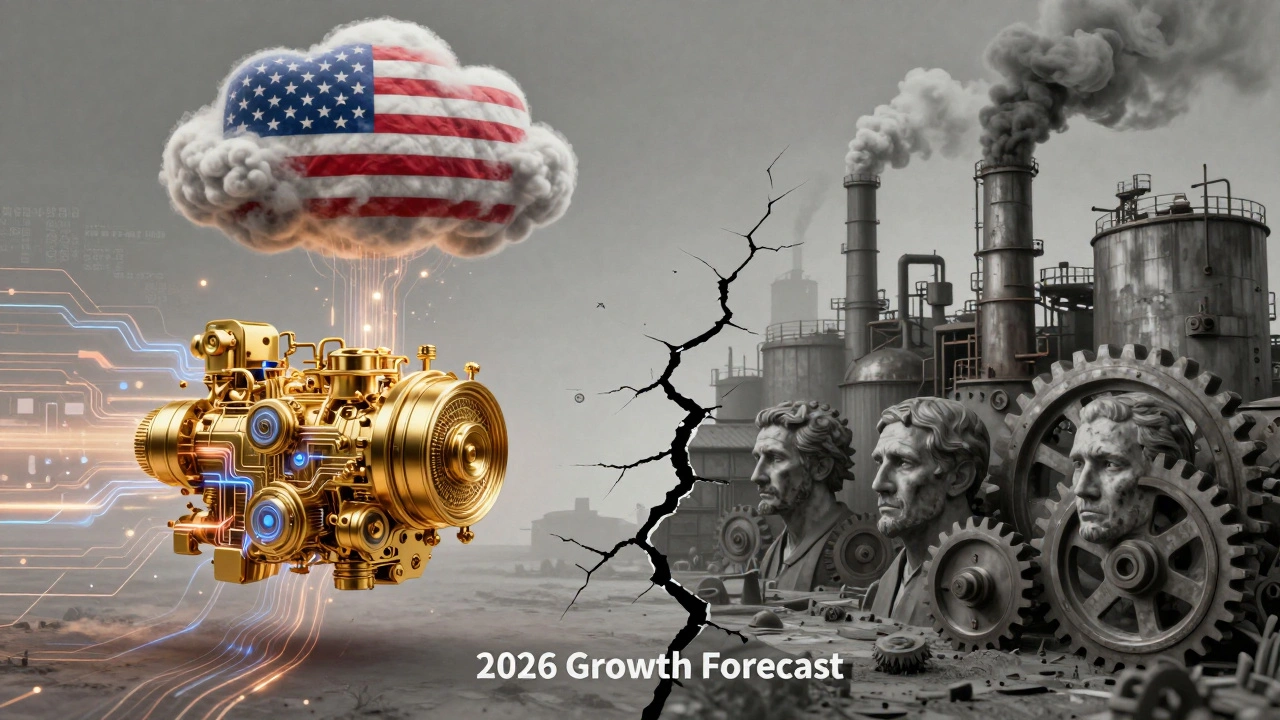
The hidden danger: AI expectations are too high
Here’s the problem: markets are pricing in miracles. Stock prices for AI-related companies have hit record highs, based on the belief that these technologies will soon deliver massive productivity gains. But the IMF is warning that this might be a bubble waiting to pop. "A reevaluation of AI productivity gains could trigger significant economic disruption," the report says. That’s not a vague warning. It’s a red flag. Think about it this way: if companies spent billions on AI tools expecting to cut costs by 30 percent and only achieve 8 percent, what happens? Investors pull back. Stock prices drop. Layoffs follow. Consumers spend less. That’s not just a tech correction - it’s a risk to the entire recovery. The Bank for International Settlements put it bluntly: "The AI investment boom risks creating asset bubbles that could burst if productivity gains fail to materialize quickly enough."Trade tensions are the other ticking clock
While the AI boom lifts some economies, another force threatens to drag them all down: trade policy chaos. On January 22, 2026, former President Donald Trump threatened new tariffs on eight European countries over the Danish territory of Greenland. The move was widely seen as symbolic - Greenland has no major exports to the U.S. - but it reignited fears of protectionism. The real danger isn’t Greenland. It’s the legal battle over whether a U.S. president can use emergency powers to impose tariffs. The Supreme Court is expected to rule in March or April 2026. If the Court strikes down the authority, markets will see it as a win for rule of law. But if the Court upholds it - or worse, leaves the issue unresolved - it opens the door for more unpredictable trade actions. The IMF says this uncertainty is already making global supply chains more fragile. The "temporary truce" between the U.S. and China from November 2025 is holding - for now. But with Trump’s threats and the Supreme Court case looming, no one is confident it will last. Goldman Sachs economists note that global trade policy uncertainty remains 42 percent higher than it was a year ago.
What this means for interest rates and your money
Stronger growth sounds good - until you realize it means higher interest rates for longer. Markets had been counting on the Federal Reserve to cut rates three times in 2026. Now, Bloomberg Economics says the odds of even one cut have dropped from 35 percent to 62 percent. That’s a massive shift. Homebuyers, small businesses, and anyone with debt will feel it. The European Central Bank is in the same boat. Inflation in the euro area is still at 2.9 percent - above target. The ECB can’t afford to cut rates until inflation drops, and with growth slowing, it’s stuck. Emerging markets are watching nervously. A stronger U.S. dollar means their debts, often held in dollars, become more expensive to repay. Twenty-eight countries faced debt crises in 2023-2024. Many are on edge again.The bigger picture: Growth is real - but it’s narrow
The IMF’s message isn’t that the world is out of the woods. It’s that we’re on a narrow path. Growth is real, but it’s concentrated in a few sectors and a few countries. The rest of the economy - manufacturing outside tech, small businesses, services in developing nations - isn’t seeing the same lift. That’s dangerous. A recovery built on AI and tech investment alone is like a house built on sand. When the tide goes out, it doesn’t just erode the beach - it takes the foundation with it. The next few months will be critical. Will AI companies deliver on their promises in Q1 2026 earnings? Will the Supreme Court rule in a way that calms trade fears? Will inflation finally break below 3 percent in the U.S. and Europe? If the answer to any of those is "no," the IMF’s optimistic forecast could quickly become outdated. This isn’t just about numbers on a chart. It’s about jobs, prices, interest rates, and global stability. The biggest international news today isn’t dramatic. It’s quiet. But its consequences will be felt for years.Why is the IMF’s forecast so important?
The IMF’s World Economic Outlook is the most widely referenced global economic forecast. Central banks, governments, and investors use it to make decisions on interest rates, budgets, and investments worth trillions of dollars. A change in its projection signals real shifts in economic conditions, not just speculation.
How is AI actually boosting the economy right now?
AI isn’t just about chatbots. Companies are using it to automate supply chains, optimize energy use in data centers, improve financial fraud detection, and speed up drug discovery. The IMF found that AI-driven investments in the U.S. added nearly 0.3 percentage points to GDP growth in 2025 - equivalent to billions in new output. This isn’t theoretical; it’s happening in factories, banks, and tech firms today.
Could the AI boom turn into a crash?
Yes. Stock prices for AI companies have soared based on expectations of huge future profits. But if those profits don’t arrive quickly - or at all - investors could panic. That could trigger a sell-off in tech stocks, which would ripple through retirement funds, pension plans, and business investment. The IMF and the Bank for International Settlements both warn this is a real risk.
What’s the Greenland tariff dispute really about?
Greenland has no major exports to the U.S. The tariff threat is symbolic - meant to pressure Denmark on geopolitical issues like mineral rights and military access. But it’s dangerous because it signals a return to unpredictable, politically driven trade actions. That scares investors and disrupts global supply chains that had just started to stabilize after years of tension.
Why are interest rates staying high even though growth is improving?
Stronger growth means inflation risks don’t go away. Central banks are worried that if the economy keeps growing faster than expected, prices could rise again. So instead of cutting rates as markets hoped, they’re likely to hold them higher for longer - even if it slows down housing or business loans.
What should I watch for in the next 60 days?
Three things: First, Q1 2026 earnings reports from major tech firms - do they show real AI-driven profits? Second, the U.S. Supreme Court’s ruling on presidential tariff powers - will it limit or expand executive authority? Third, any signs of retaliation from the EU over Greenland - if trade tensions escalate, global markets will react fast.



About Author
