Is the Wall Street Journal liberal or conservative? The truth behind the bias
WSJ Bias Checker Quiz
How Well Can You Spot the WSJ Bias?
The Wall Street Journal has two distinct voices: neutral news reporting and conservative opinion. Test your ability to identify which section you're reading.
Answer 4 questions about WSJ content. You'll get immediate feedback on your choices.
Question 1: "Federal Reserve Raises Interest Rates by 0.25%"
Question 2: "Biden's Climate Policies Will Crush American Jobs"
Question 3: "Climate Science Is Clear: 97% of Scientists Agree"
Question 4: "Trump's Tax Cuts Boosted Middle-Class Pay"
Ask someone if the Wall Street Journal is liberal or conservative, and you’ll get three different answers-depending on whether they read the news section, the opinion pages, or just heard a headline. The truth isn’t simple. It’s split down the middle-literally.
The news section doesn’t look conservative
If you open the Wall Street Journal’s front page on a Tuesday morning and scan the headlines, you won’t find the usual red-meat conservative rhetoric. You’ll see balanced reporting on Federal Reserve policy, corporate earnings, global supply chains, and international trade deals. There’s no outrage. No demonization. Just facts, data, and context.That’s not an accident. For decades, the WSJ newsroom operated with a strict firewall between its journalists and its editorial board. Reporters were expected to stick to verified sources, avoid editorializing, and focus on business and economic reporting. In 2025, AllSides conducted a blind bias survey of 1,328 readers across the political spectrum. They removed bylines, logos, and any identifying markers from WSJ articles and asked participants to rate the tone. The result? The news section scored a 0.33 on a scale from -2 (left) to +2 (right). That’s center.
Even Pew Research Center data from 2014 showed WSJ readers were nearly evenly split: 22% identified as mostly conservative, 21% as mostly liberal, and 24% as mixed. That’s rare for a major U.S. paper. The New York Times leans left in its readership. Fox News leans right. The WSJ? It’s a neutral zone for business readers who care more about interest rates than ideology.
The opinion section is a different world
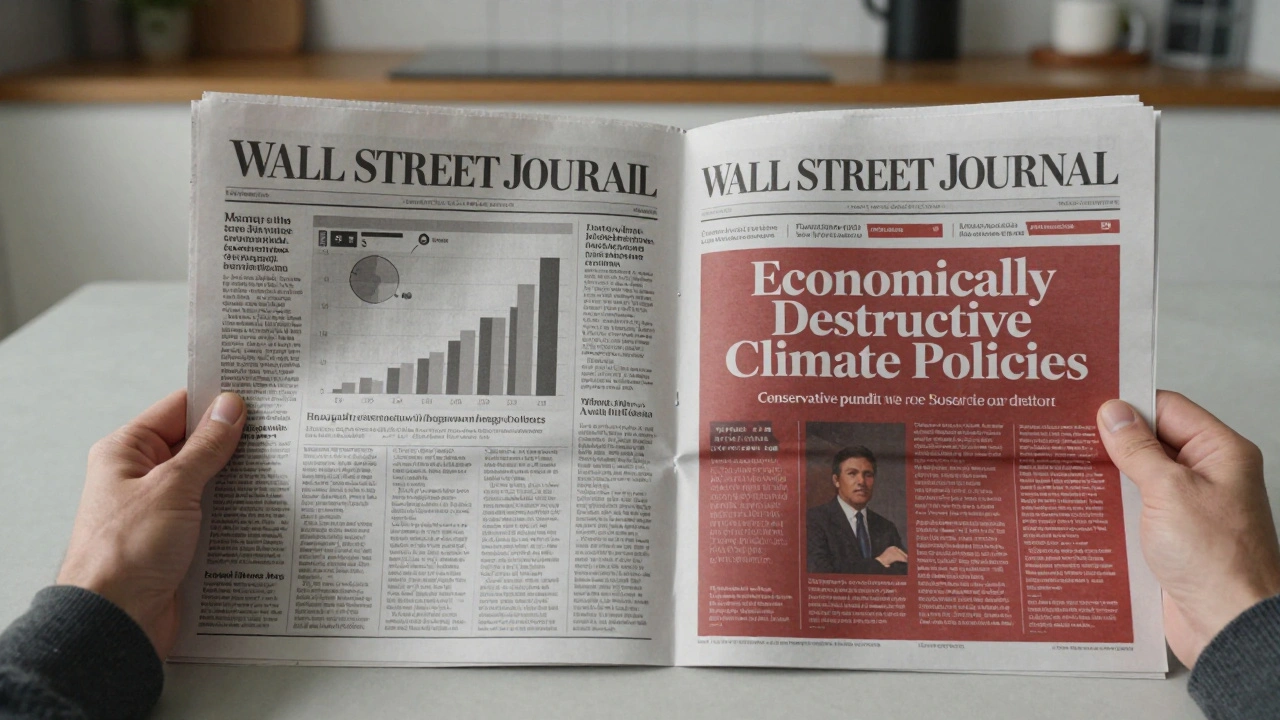
Flip to the opinion pages, and everything changes. The WSJ editorial board has been a vocal advocate for lower taxes, deregulation, and free-market capitalism since the 1970s. It endorsed Ronald Reagan. It supported Trump’s tax cuts. It criticized Biden’s climate policies as “economically destructive.”It’s not just opinion pieces. The editorial board writes daily editorials-signed, bold, and unapologetically conservative. In 2021, the Columbia Journalism Review reported internal staff saying editors were instructed to “modulate the tone” of political stories to avoid offending “white readers.” One former editor told the outlet that coverage of race was restricted unless it didn’t “compare” groups. That’s not journalism. That’s agenda.
Media Bias/Fact Check rates the WSJ opinion section as “Lean Right” and gives the whole paper a “Right-Center” bias score. Why? Because they weigh the editorial voice more heavily. And they point to the paper’s history of publishing climate denial pieces like “The Phony War Against CO2” and refusing to acknowledge the 97% scientific consensus on global warming. Climate Feedback, a fact-checking network, has labeled multiple WSJ opinion articles as having “very low scientific credibility.”
Who owns the Wall Street Journal-and how it changed
The WSJ was founded in 1889 as a business paper. For most of its history, it was run by the Dow Jones family. But in 2007, Rupert Murdoch’s News Corp bought it. That’s when things started shifting.Before Murdoch, the editorial board was conservative, but the newsroom was insulated. After the takeover, internal emails leaked showing increased pressure on reporters to align coverage with the paper’s political leanings. In 2019, a senior editor resigned after being told to downplay coverage of Trump’s legal troubles. In 2021, the opinion editor left over disagreements about how to handle Trump’s post-election claims.
Journalists inside the paper reportedly called the editorial division “Nazis” and said the two sides were as divided as North and South Korea. That’s not hyperbole-it’s a quote from a 2005 study in the Quarterly Journal of Economics. The separation was real. And now, it’s fraying.
The contradictions no one talks about
Here’s where it gets weird. One study, published by UCLA and cited by David R. Henderson on Substack, claims the WSJ’s news section is “more liberal than The New York Times.” Another, by economist Groseclose, ranked the WSJ as the “most liberal” media outlet in the U.S. based on how often politicians were quoted. That’s not a typo. The math said it was left-leaning.Meanwhile, Ad Fontes Media, which uses panels of left, right, and center analysts to rate media, calls the WSJ “neutral/balanced” and “most reliable.” Reuters Institute found 46% of Americans trust the WSJ’s news coverage-fourth highest in the U.S. Only AP, NPR, and BBC scored higher.
So why the chaos? Because the WSJ is two newspapers in one. The news section reports on markets, earnings, and policy. The opinion section pushes policy. You can’t rate the whole thing as liberal or conservative without saying which part you mean.
What does this mean for readers?
If you’re reading the WSJ for stock tips, Fed updates, or earnings reports, you’re getting solid, fact-based journalism. It’s not perfect, but it’s reliable. If you’re reading the opinion section for political commentary, you’re getting a consistent, pro-business, free-market worldview. That’s not news. That’s advocacy.Many readers don’t realize they’re consuming two different products. They see the WSJ logo and assume it’s all the same tone. That’s dangerous. A 2024 survey by Media Bias/Fact Check found 68% of WSJ readers couldn’t tell the difference between a news article and an editorial.
The paper doesn’t help. It doesn’t label opinion pieces with clear banners like The New York Times does. You have to know to look for the “Editorial” or “Opinion” tag. If you miss it, you might think a conservative op-ed is a news report.
Is the Wall Street Journal trustworthy?
Yes-if you know what you’re reading.Its business reporting is among the best in the world. Its coverage of the economy, markets, and global trade is detailed, accurate, and sourced. Journalists in the newsroom still follow traditional standards. They verify facts. They quote multiple sides. They don’t push narratives.
But if you’re reading the opinion pages, you’re getting a political argument. It’s not neutral. It’s not balanced. It’s designed to persuade. And it’s been getting more extreme.
There’s no single answer to whether the WSJ is liberal or conservative. It depends on where you look. The news section? Center. The opinion section? Right-leaning. The whole institution? A hybrid that’s losing its way.
Readers who want truth should treat the WSJ like a Swiss watch: two separate mechanisms working side by side. Know which one you’re using. Otherwise, you’re being misled-even if the facts are right.



About Author
