Metro News UK: The Free Newspaper That Became the Country’s Most Read
Metro News UK Comparison Tool
Compare UK Newspapers
Newspaper Comparison
| Feature | Metro | Daily Mail | The Sun | The Guardian |
|---|---|---|---|---|
| Price | Free | £1.20 | £1.00 | £1.50 |
| Format | Tabloid | Tabloid | Tabloid | Broadsheet |
| Political Bias | None | Right-leaning | Right-leaning | Left-leaning |
| Primary Focus | Entertainment, local news | Politics, opinion, celebrity | Celebrity, sports, scandal | Politics, international news |
| Distribution | Commuter hubs | Newsstands, subscriptions | Newsstands, subscriptions | Newsstands, subscriptions |
| Most Read (2017) | 1.47 million | 1.24 million | 1.21 million | 880,000 |
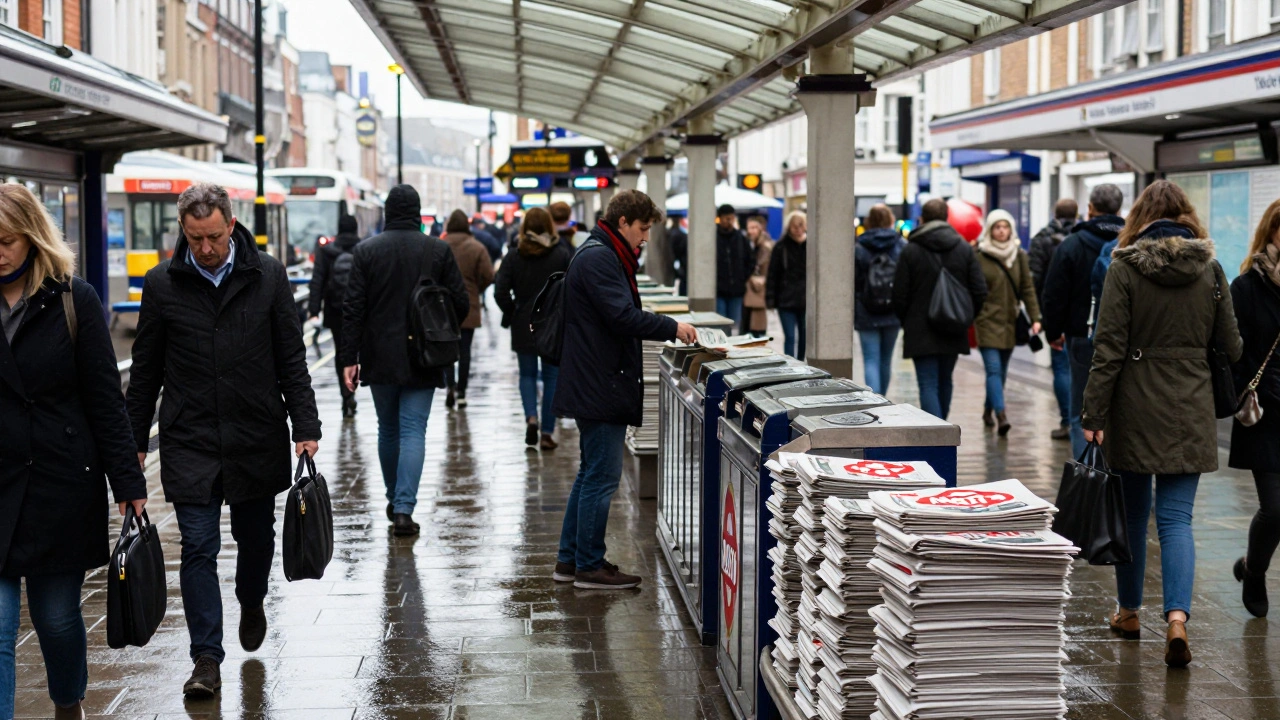
On a rainy Tuesday morning in 2026, over a million people in the UK grab a copy of Metro from a bin outside their local tube station, bus stop, or train platform. It’s not the Daily Mail. It’s not the Sun. It’s not even a paid subscription. It’s free. And since 2017, it’s been the most-read newspaper in the country.
How a Free Paper Took Over Britain’s Commuters
Metro didn’t start with a big budget or a famous editor. It started with a simple idea: give people something quick, clean, and distraction-free during their daily commute. In March 1999, DMG Media launched Metro in London with just 85,000 copies. No ads for political rallies. No opinion columns screaming about the royal family. Just facts, local stories, celebrity gossip, and sports scores - all in a compact tabloid format designed to fit in a handbag or coat pocket.
The founder, Jonathan Harmsworth (Viscount Rothermere), got the idea after visiting Stockholm and seeing how Metro International’s free paper was flying off stands in Sweden. He brought that model home, but with one key twist: make it completely apolitical. Paul Dacre, then editor-in-chief of the Daily Mail, told the team: "Metro could have no ideology." That decision was genius. While other papers fought over Brexit, immigration, or the monarchy, Metro stayed out of it. It became the neutral ground for people who just wanted to know what happened while they were on the train.
From London to Every Major City - Fast
Within eight months, Metro was in Manchester. By 2001, it had reached Glasgow, Edinburgh, Newcastle, Leeds, and Birmingham. By 2004, it was in Bristol, Bath, Nottingham, Cardiff, and Liverpool. Each edition had local content - a pub review in Manchester, a theater listing in Edinburgh, a traffic update in Birmingham - but the core news stayed national. That balance worked. People didn’t want to read the same thing everywhere, but they also didn’t want to wait for a national paper to catch up.
Production moved from Surrey Quays to Northcliffe House in Kensington in 2006, and today, Metro prints 10 regional editions across 12 sites. It’s distributed in over 50 cities, from Glasgow to Portsmouth. Even as other newspapers shut down regional bureaus, Metro kept its local flavor alive - until 2009, when economic pressure forced it to close five regional offices. But the core model stayed: fast, free, and focused on the commute.
The Day It Beat the Sun
In November 2017, something unthinkable happened. Metro’s circulation hit 1.47 million. That was more than the Daily Mail (1.24 million) and more than The Sun (1.21 million). For the first time since 1978, The Sun wasn’t the most-read newspaper in the UK. And it wasn’t even a paid paper.
Rupert Murdoch had seen the threat coming. In 2005, he admitted he was "worried" about Metro. So he launched his own free evening paper, The London Paper. It cost nothing. It had glossy pages. It even had celebrity interviews. But it died in 2009 after losing millions. Metro didn’t just survive - it thrived. Why? Because it didn’t try to copy The Sun. It didn’t chase scandal. It didn’t shout. It just showed up, every morning, in the same bins, with the same tone: simple, clear, no spin.
What’s Actually in the Paper?
Open any copy of Metro and you’ll find:
- A short headline on the front - often crime, health, or a local event
- A two-paragraph summary of the UK’s top story
- Entertainment: new movie releases, TV spoilers, celebrity gossip
- Sports: Premier League scores, rugby results, boxing updates
- A puzzle or quiz - usually Sudoku or a quick word game
- A weather forecast for the day
- A small section on lifestyle: recipes, dating tips, or mental health
There’s no editorial page. No letters to the editor. No op-eds from politicians. That’s intentional. Metro’s audience doesn’t want to be preached to. They want to know what happened, what’s on TV, and whether it’s going to rain. Media Bias/Fact Check gives Metro a "medium credibility" rating - not because it’s unreliable, but because it doesn’t dig deep. It’s not meant to. It’s a breakfast paper, not a textbook.
Why It Works - And Why It Might Not Last
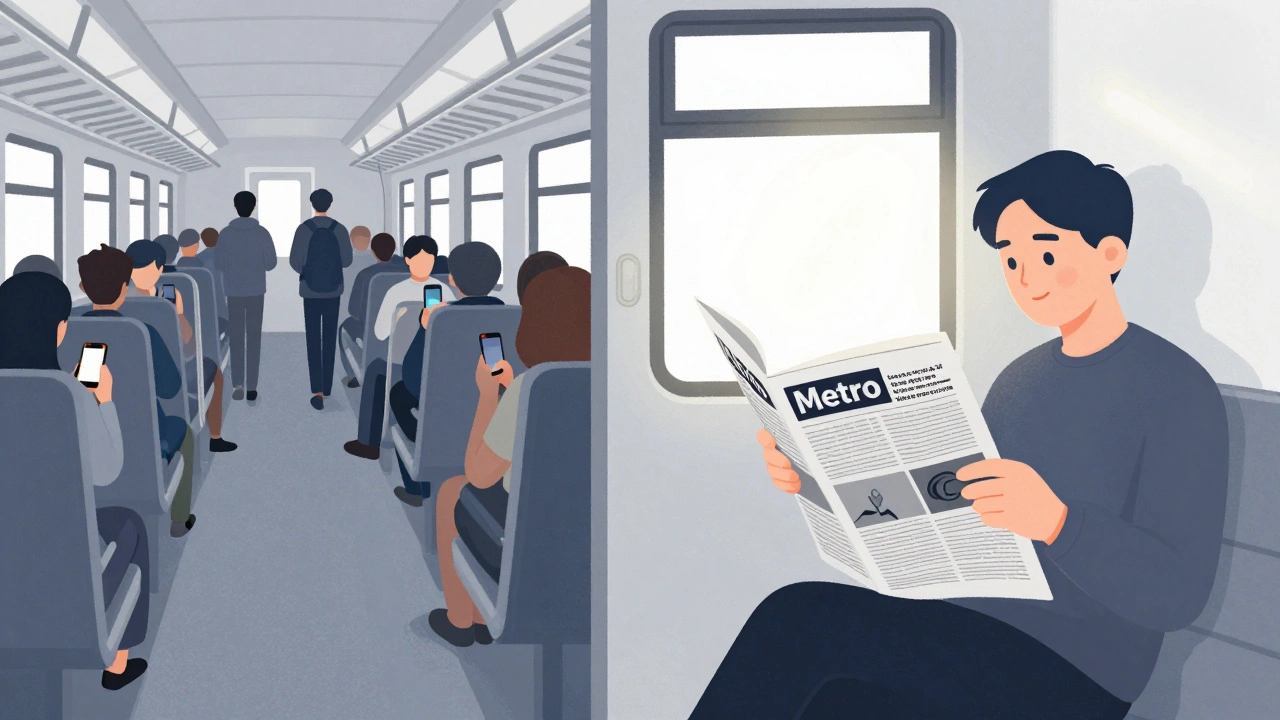
The secret isn’t just that it’s free. It’s the timing. Metro captures what its early marketing team called the "Metro Moment" - those 20 minutes between leaving home and arriving at work. That’s when people are mentally checked out. They’re not scrolling on their phones. They’re tired. They want something easy. Metro gives them exactly that.
Mike Anderson, one of Metro’s first executives, described it perfectly: "Commuters think, ‘I hate my job, I hate my boss, I want to set up a bar in Thailand.’ And then they turn the page and read about a cat who saved a baby. And for a moment, it’s okay."
But the world is changing. Fewer people take the tube. Fewer people ride buses. More people read news on their phones. Print circulation has dipped slightly since 2017. Metro hasn’t announced a digital-only plan. It still prints over a million copies every weekday. But if the commute disappears, what happens to the paper?
For now, it survives because it’s still the most convenient option for millions. It’s not trying to be the Guardian. It’s not trying to be the Times. It’s just there - in the bin, on the seat, in your hand - when you need it.
The Bigger Picture
Metro didn’t just change how people read news. It changed how publishers think. Before Metro, no one believed you could make money with a free paper. After Metro, every major media group tried to copy it. Most failed. Metro succeeded because it understood its audience better than anyone else.
It didn’t need to be the smartest paper. It didn’t need to be the most serious. It just needed to be the easiest. And in a noisy, overwhelming media landscape, that’s worth more than you’d think.
Today, Ted Young is the editor. He’s kept the same rules: no politics, no bias, no fluff. The paper still opens with a single headline. Still ends with a weather update. Still fits in your pocket. And every morning, just like it did in 1999, it shows up - exactly where it’s supposed to be.
What Makes Metro Different From Other UK Newspapers?
Here’s how Metro stacks up against the big names:
| Feature | Metro | Daily Mail | The Sun | The Guardian |
|---|---|---|---|---|
| Price | Free | £1.20 | £1.00 | £1.50 |
| Format | Tabloid | Tabloid | Tabloid | Broadsheet |
| Political Bias | None | Right-leaning | Right-leaning | Left-leaning |
| Primary Focus | Entertainment, local news | Politics, opinion, celebrity | Celebrity, sports, scandal | Politics, international news |
| Distribution | Commuter hubs | Newsstands, subscriptions | Newsstands, subscriptions | Newsstands, subscriptions |
| Most Read (2017) | 1.47 million | 1.24 million | 1.21 million | 880,000 |
Metro’s lack of bias isn’t a weakness - it’s its strength. In a time when people are tired of being told what to think, Metro just tells them what happened. And that’s enough.
Is Metro News UK still in print?
Yes. As of 2026, Metro continues to print over a million copies every weekday. It’s distributed for free at train stations, tube stops, bus terminals, and university campuses across the UK. While digital readership is growing, print remains its core format because it reaches commuters at the exact moment they’re looking for quick, distraction-free news.
Who owns Metro News UK?
Metro is owned by DMG Media, part of the Daily Mail and General Trust (DMGT). DMGT also owns the Daily Mail, MailOnline, and other UK publications. Metro was created as a separate brand to avoid competing with DMGT’s paid papers, but it now serves as a major audience driver for the company’s overall media reach.
Why is Metro so popular with commuters?
Metro was designed specifically for the 20-minute commute. It’s short, visually clear, and avoids deep political analysis. People don’t read it to form opinions - they read it to pass time. The layout is easy to scan. The headlines are bold. The stories are quick. It’s the perfect snack-sized news for people who don’t have time for a long read.
Does Metro have a digital version?
Yes, Metro has a website and app with daily updates, videos, and breaking news. But the digital version doesn’t replace the print edition - it complements it. Most users still get their daily fix from the paper. The digital platform is used more for real-time updates, like traffic alerts or major breaking stories, but it hasn’t shifted the core business model.
Is Metro politically biased?
No. Metro was explicitly created to be apolitical. It doesn’t endorse candidates, take sides on policy debates, or publish opinion columns. Its goal is to report facts without spin. While some critics say this makes it shallow, supporters say it’s refreshing. In a media landscape full of outrage, Metro stays calm.
What was Metro’s first headline?
The first front-page headline on March 15, 1999, covered the murder of a female solicitor and civil rights activist in Northern Ireland. The story was serious, but the tone was clear and factual - no sensationalism. That set the standard: credible news, delivered simply.
Can I get Metro outside the UK?
Metro used to be published in Ireland and Sweden, but those editions closed. The Irish version merged with Herald AM in 2010 and shut down in 2014. There is no official international version today. The UK edition remains the only active one.
What’s Next for Metro?
Metro’s future isn’t about becoming a digital giant. It’s about staying exactly what it is: the paper you grab on your way to work. As long as people commute, Metro will be there. It doesn’t need to be the biggest. It just needs to be the easiest. And for now, that’s still enough.

About Author
